 adminOctober 29, 2025
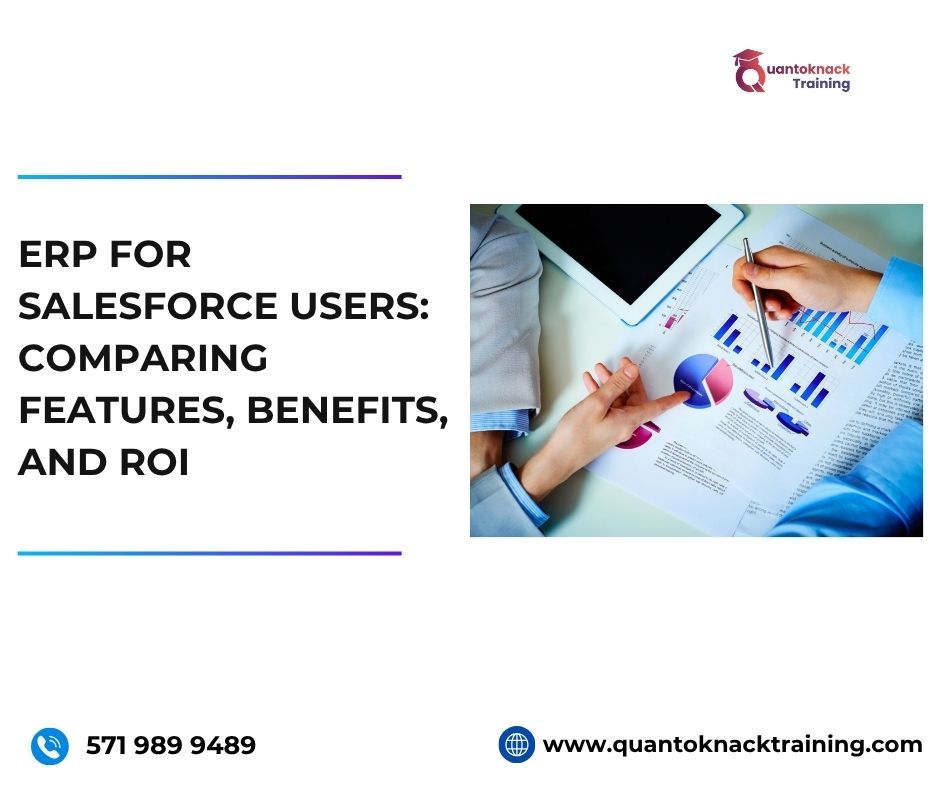
What if I told you that you have a business to run, and for that, you need to monitor several different tools? Sounds chaotic, right? But by integrating Enterprise Resource Planning (ERP) systems with Customer Relationship Management (CRM) tools like Salesforce, you don’t have to worry about the chaos anymore. The whole process gets faster with this integration. Connecting ERP to Salesforce means that companies establish a single system that improves transparency, simplifies interaction with customers, and enables the company to make more intelligent, data-driven decisions.
At present, Salesforce is the leading CRM platform for managing sales pipelines, marketing activities, and customer relationships. However, it does not have built-in features for business areas such as finance, supply chain, and inventory management. This blog wil0000l give you deeper insight into the integration of ERP and CRM, which is beneficial for your business in the long run. Furthermore, it illustrates how team empowerment through Salesforce admin training and Salesforce AI training can lead to maximum returns.
What is ERP and Salesforce?
Enterprise Resource Planning (ERP) is a software system that uses a centralized database to manage a company’s internal operations, such as finance, HR, procurement, and supply chain. The unified platform gets rid of the data silos, which in turn allows better decision-making and increases efficiency to be increased.
Salesforce, in contrast, is geared towards managing customer relationships, sales, and marketing. The customer-facing teams are made more powerful through the use of this tool, but the back-office processes are not handled by it.
Simply speaking:
• CRM = Customer-focused system
• ERP = Business operations-focused system
The connection of ERP to Salesforce is the solution that adequately addresses the problem leaving organizations with the option to take advantage of both systems for a more integrated business strategy.
Difference between CRM and ERP: Comparing Features
1. Functionality
CRM tools like Salesforce are used by sales, marketing, and support teams to manage contacts, communication, and performance, making the task easy for the employees within the organization. However, ERP is used by finance, HR, and operations to manage accounting, payroll, procurement, and compliance. Integrating these systems eliminates data duplication and allows all departments to operate from the same insights, which also means easier handling and processing of data.
2. Data Management and Automation Capabilities
One of the major differences between the tools is, CRM systems track customer-centric data which includes managing leads, handling communications, and support cases, while ERP tools manage operational data for the organization like managing invoices, inventory, and production schedules. Integrating both, provides a single, automated tool to manage for both departments, which ensure seamless workflows, fewer manual errors, and faster processes.
3. Analytics, Reporting, and Seamless Integration
CRM analytics focus on sales performance and customer engagement, while ERP analytics cover cash flow, cost control, and resource utilization. When integrated, they deliver unified business intelligence like real-time dashboards with both operational and customer metrics.
Scalability is another and one of the best advantage of both the tools. CRM can handle growing customer bases and marketing channels, while ERP scales across multiple entities and regions. The result has real-time visibility and shared insights for better decision-making.
4. Technology Architecture and ROI Contribution
CRM like Salesforce is web-based, which means it provides versatile access to the users on the move and offers AI features alongside with other benefits. As for the ERP, it also moves to the cloud and focuses on security, compliance, and automation aspects. Doing both leads to a win-win situation for the business. Which means after integrating both, operations are not only secure and scalable but also intelligent.
CRM is the one that brings more money into the company vault by making customers happier, while ERP is the one that ensures profits are higher through resource optimization and cutting back on operational costs. The result of their partnership is a solid measurable return on investment (ROI), which is in line with sales insights and operational execution, thus leading to sustainable business growth.
Calculating ROI of ERP-Salesforce Integration
Return on Investment (ROI) is a crucial metric for evaluating the effectiveness of Salesforce and ERP integration. It helps businesses quantify how much value they gain from technology investments compared to their costs.
ROI Formula:
ROI= Net Benefits ( Gain from Investment – Cost of Investment ) × 100
Cost of Investment
Example:
If your organization invests $25,000 in Salesforce-ERP implementation and gains $45,000 in productivity savings and process improvements within a year, the ROI would be:
( $45,000 − $25,000 ) × 100 = 80%
$25,000
This demonstrates that for every pound spent, the business earns $1.80 in return — a clear indicator of efficiency and value.
Benefits of Integrating ERP for Salesforce Users
By connecting an ERP system with Salesforce, a company obtains a single platform that merges client-facing operations with backend activities. This connection enhances the company’s operations with less effort, brings more accuracy into the data handling processes, and makes the company management more efficient across different departments. The main advantages are:
- Operational Efficiency at a Higher Level: The process of Automation in order handling, billing, getting the approvals, and quoting will lessen the manual work. Integration will remove double entries, lessen errors, and speed up the flow of work, thus enabling employees to concentrate on strategic initiatives.
- Data Accuracy and Consistency to a High Degree of Reliability: The data synchronization between CRM and ERP is the guarantee that all departments will have reliable, up-to-date information. Reporting and forecasting become more accurate, and decision-making is supported by a full set of customer and operational data.
- Besides, Unified Insights Are Enabling Better Decision-Making: Predictive analytics can be improved by AI training of Salesforce, which can provide the companies with the necessary information about the demand they can anticipate, anomalies that are to be detected, and trends that can be identified. When combined with Salesforce admin training, users will be able to handle their dashboards and reports in an efficient way, thus getting a full picture of sales, operations, and profitability.
- Faster Cash Flow Plus the Reduction of Cycle Times: The integration of ERP and Salesforce is the main reason for the streamlining of the quote-to-cash process. As a result, invoicing is accelerated and the delays are minimized, thus helping to improve working capital management and bringing about faster revenue recognition.
- Reduction in the Cost and Compliance with the Regulations: Integration leads to a decrease in the running expenses of a business by eliminating manual tasks and IT overhead from disparate systems. Apart from that automated workflows and centralised records will be in assistance to regulatory compliance as well as audit readiness, thus giving less room for risk and keeping up with the standards.
- Support for Scalability and Growth: When systems are integrated, they can expand together with the business as it grows and thus the data will remain consistent and the processes efficient, regardless of if the business has more customers, new products, several locations, or is operating globally.
Role of Salesforce Admin Training & Salesforce AI Training in Maximising Returns
The Live Salesforce Admin Training from Quantoknack Training enables learners to combine core Salesforce administration skills with new AI capabilities in a way that is both innovative and profitable for the business. By going through the practical modules on system configuration, automation, data integrity, and AI-driven insights, students will be able to streamline workflows, eliminate operational bottlenecks, and in general, find the most efficient ways to use their CRM and ERP systems.
Once the participants have mastered the administrative best practices along with Salesforce-native AI tools, they will be in a position to shorten the quote-to-cash cycle, increase the forecast accuracy, detect the anomalies in real time, and thus increase the output of the organization from the very first day.
Conclusion
Incorporating an ERP system with Salesforce for organizations opens a significant avenue to propel business transparency, accuracy, and efficiency, and also to accomplish a tangible return on investment. To achieve success, pick an ERP that matches the essential characteristics of your business (finance, inventory, analytics, scalability), use a clear ROI model, and spend money on Salesforce admin and Salesforce AI training. Your integration will probably do more than just break even with itself and may even become the basis of your long-term growth.