 adminOctober 10, 2025
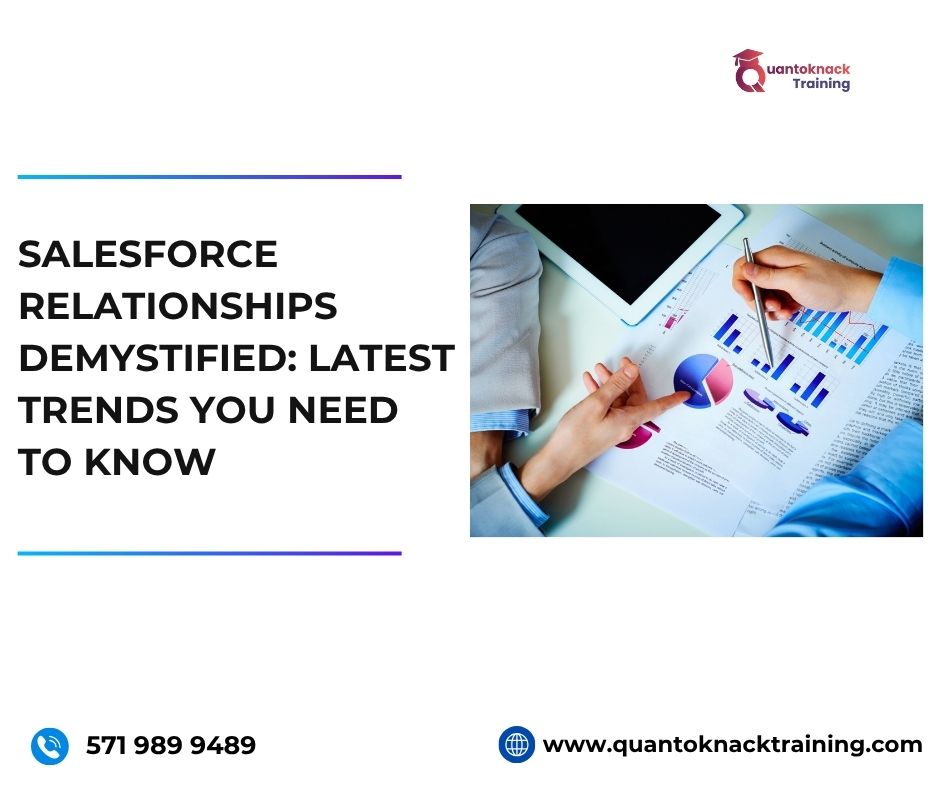
Salesforce relationships used to be primarily focused on technical objects, such as Lookup and Master-Detail, but are now shifting towards a more strategic approach through its Customer Data Platform (CDP) and Generative AI. Even the online Salesforce developer training is covering more advanced areas of systems, including AI, Einstein, and more.
These aspects help build more trusted hyper-personalized customer and exceptional employee experiences. Organizations need data-driven, customized interactions across all customer touchpoints in order to achieve growth and solve various challenges. AI is the latest trend, and the Salesforce system has implemented it to make every interaction humanized, integrate Slack for employee collaboration and flexibility, and create a broader Salesforce ecosystem for partners for a better experience.
Let’s explore the various trends of 2025 that will be great in 2026 as well.
Customer and Employee Experience Trends
Customers and employees are the two most important aspects of the system; catering to them can change and add great value to the organization. So, it is crucial to understand the trends that can support you in providing them with the best experience.
- Hyper-Personalization: Salesforce is using its Customer Data Platform (Salesforce Customer 360) and Marketing Cloud/Commerce Cloud to unify customer data, enabling businesses to create personalized experiences across all channels.
- AI-Powered Interactions: Salesforce has also integrated generative AI in the system, as it is the need of the hour to humanize interactions and build more relevant customer experience.
- Employee Experience: Developers using Salesforce to provide flexibility to employees is another trend. Leveraging tools like Slack can enhance communication and collaboration within teams and even between departments. It is important to understand employee needs for a more positive workplace culture.
Platform and Ecosystem Trends
The Salesforce platform offers great trends for a unified customer and employee experience.
- Unified Data: Organizations that utilize the Salesforce Customer 360 platform continue to evolve & serve as a central, unified view of customer data and create a single source of truth for businesses.
- Ecosystem Growth: The certified experts, consulting partners, and app vendors play a vital role in delivering solutions and driving customer success across industries, expanding the Salesforce partner ecosystem rapidly.
Technical Relationship Trends: The Core Pillars
The Salesforce platform relies on specific data relationships, as strategic emphasis is on relationships with customers and employees.
- Lookup Relationships (The Loose Connection)
Salesforce developers use Lookup relationships to create a connection between a child and parent objects, following the most usual and effortless way, but with a loose one-way association.
How it works: An 18-character Salesforce ID of the related parent record gets stored in the field on the child object.
Key Features:
- Independent Sharing: The child record does not use parent’s sharing and security settings. They follow their own independent setting.
- Optional Parent: The lookup field can be null as it is not mandatory. If you delete the parent record, the child record will not be deleted automatically. However, the Salesforce developer will require an Apex trigger to handle deletion and archiving logic, as deleting the parent record will clear the lookup field.
- Many-to-Many Relationships (The Junction Object)
Developers can make the process of linking multiple records of object A to many records of object B easy by using the Junction object. It combines two Master-Detail relationships on a single custom object.
How it works: The Junction Object becomes the “detail” in two separate Master-Detail relationships with the two “master” objects.
Key Features:
- Two Masters: Although the junction object inherits sharing from both masters, it is crucial to designate one of them as the Master for a better look and feel, and give ownership to one record.
- Roll-up Flexibility: You can roll up the data from the junction object, getting the freedom to create roll-up summary fields on both master objects.
The Developer Takeaway: Even in the most difficult business scenarios, you can use these standard patterns. It helps link students to multiple courses or projects with multiple team members.
- Master-Detail Relationships (The Ownership Bond)
You can use the Master-detail relationship as the most powerful link in the Salesforce environment, as it will help you define a strong parental ownership between two records.
How it works: The master record creates and manages the detailed child record.
Key Features:
- Cascading Deletion: If you delete the master record, it deletes all associated detail records automatically. Hence, developers can make the most of cascading deletion to maintain data integrity.
- Inherited Sharing: Detail records receive all the data, including sharing, owner, and security settings through inheritance.
- Roll-up Summary Fields: It is an excellent feature utilized by Salesforce developers on the master object to count, sum, find the minimum, or find the maximum of fields on detail records.
The Developer Takeaway: You can enforce data integrity where child record is a true component of the parent record. Master-detail relationship is perfect for this as it requires managing financial data, line items, or more with restrictive sharing and conversion rules.
Career Path: Mastering the Modern Relationship
In 2026, Candidates looking for a successful career in Salesforce must attain skills and credentials with online Salesforce training programs.
- The Value of Salesforce Developer Training
To get started or level up your skills in Salesforce, both demand targeted Salesforce developer training from a reputable program provider. QuantoKnack training courses are highly recommended and chosen by students, as we have online classes with on-demand recorded sessions. We focus on the practical application of data modeling principles:
- Live & Recorded Sessions: You can attend live Salesforce developer training classes from anywhere, at any time, and even get a recording of all the classes so that you can watch any of your missed classes later on. Not only this, but you get lifelong access to the resources.
- Hands-on Practice: You can work on various live projects with the experts. It will increase your knowledge and ability to solve complex case scenarios that will strengthen you even in your future jobs.
- Curriculum: Experts will guide you about topics such as indexing, selective SOQL, data archiving strategies, Salesforce Connect, Data Cloud, and MuleSoft basics, as these are crucial for Salesforce relationships.
- Placement: Get a chance to work with highly-reputed organizations partnered with our Salesforce developer training and certification programs.
- Earning Your Salesforce Developer Certification
Validate your abilities and skills in developing and implementing complex, scalable solutions with the Salesforce developer certification. Becoming a certified Salesforce developer, highlights your abilities and skills in creating a scalable solution for any industry by creating and implementing complex structure. You have options like Salesforce Certified Platform Developer I and Platform Developer II that place heavy emphasis on data modeling and querying.
You need to learn more than just the difference between various types of Relationships. It requires more to become an expert in the field.
- Design for Scale: Prevent LDV issues in a master-detail hierarchy
- Ensure Data Integrity: Enforce business logic by choosing the right relationship type.
- Optimize for Performance: Avoid governor limits and non-selective errors by efficiently traversing relationships and writing Apex and SOQL languages.
When you take the Salesforce developer certification exam, it proves that your knowledge is more than defining relationships in Salesforce. It takes complete knowledge from creating to implementing the complete system as per the business need.
Conclusion
The Salesforce relationships turn a powerful, single-system CRM into an all-encompassing, enterprise-wide ecosystem. Tools like Data Cloud and Salesforce Connect empower the foundational relationships (Lookup, Master-Detail, Many-to-Many) by augmenting them with sophisticated external models and real-time connectivity.
For students or professionals preparing for Salesforce developer and architect roles, it is crucial to gain the ability to model, optimize, or integrate data relationships of AI and LDV hinges across both the core and external systems.